

This story was originally posted in South China Morning Post on 27 November.
Eight village houses and some temporary structures in Kai Hang Tun village in Sai Kung lost stable water supply on November 14, and the problem remained unresolved as of Wednesday, the Post learned.
The department attributed the shortage to weakened water pressure caused by a leak. It said it had already replaced 60 per cent of the affected water mains and expected normal supply to resume once the work was completed by the end of the week.
“We found that the existing water mains providing fresh water supply to Kak Hang Tun village are leaking, causing insufficient supply pressure,” the department said on Wednesday in a reply to the Post’s inquiry.
The department said it expected normal supply pressure to resume once the repairs were completed by November 30.
“We will expedite the works to restore normal supply pressure as early as possible,” it said.
Villagers have expressed concerns over unclear communication from authorities, significant inconvenience, and potential fire risks caused by the water shortage.
Wendy Maize, a 67-year-old retiree, told the Post that the water shortage had affected basic chores such as cooking and doing the laundry, as well as showering and even flushing the toilet.
She also highlighted the fire hazard posed by the shortage, as the village was near graveyards and surrounded by dense trees.
“Sometimes we get a trickle, but it has a really odd smell. We don’t even know if we should boil that water and drink it,” Maize said.
Her major concern was the risk of a blaze, amid the current fire season.
“My Thanksgiving celebration is on Friday but I am probably going to have to hold it somewhere else,” she said.
When the Post visited her home on Wednesday, the kitchen tap produced only a faint trickle while the toilet on the first floor and the entire second floor had no supply at all.
Maize and her husband relied on fetching water from a tank set up by the department, and sometimes went to their friend’s place to bathe.
With many graves nearby, Maize was worried that if a lit incense stick sparked a fire, there would be insufficient water sources nearby to extinguish it.
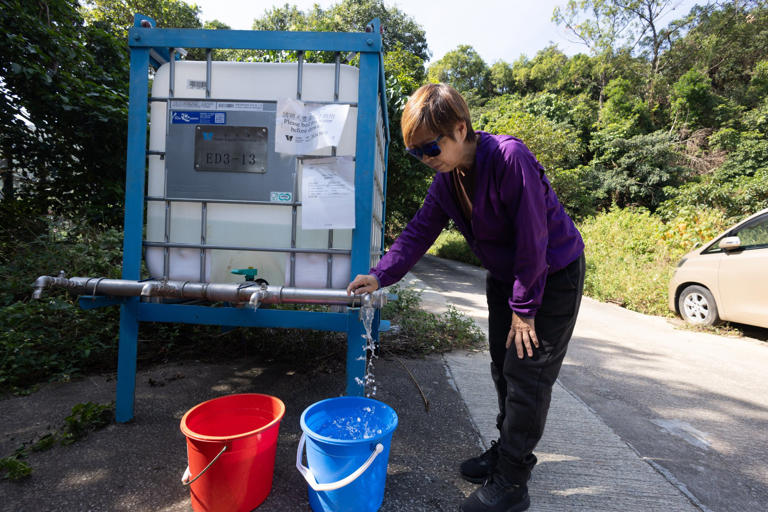
Yip says her arms are sore from carrying water buckets to her home every day. Photo: Dickson Lee
Another resident surnamed Yip, who is in her sixties, said this was the longest water disruption in her 30 years in the village, with previous outages lasting only one or two days.
“At first, I used to drive to fetch the water but I could not lift the bucket to the boot because it was so heavy,” Yip said. “Now I need to carry the buckets from the tanks to my home, which makes my arms very sore.”
Simon Li Wah, a 62-year-old resident, expressed frustration over the slow response and poor communication regarding the shortage.
“I feel the department should do a better job supervising the progress, although the actual work is carried out by contractors,” Li said. “We need someone to talk to and get updates from, but no one has checked in with us.”
Maize said she had alerted the Fire Services Department about the fire risk and demanded more information from a district councillor, but had received no assurances or useful updates.
The department told the Post that water mains replacement work began last Wednesday. As of Tuesday, 320 metres (1,049 ft) of the total 520 metres of new water mains had been installed.
It also said it had taken measures immediately after it received a report on November 15, including flushing domestic meters and carrying out leak detection to investigate the cause.
Copyright (c) 2025. South China Morning Post Publishers Ltd. All rights reserved.


Be the first to comment